
Your junk drawer isn't just a chaotic void where stuff goes to die. It's actually a container – and once you start thinking about your home this way, everything changes.
What Makes Something a Container?
In Stashdog, a container is anything that holds something else. We're talking about a beautifully simple concept that maps perfectly to how your brain already works:
- Toolbox → contains your drill, screwdrivers, and that weird socket wrench you've never used
- Kitchen cabinet → contains your dishes, mugs, and seventeen different coffee makers
- Backpack → contains your laptop, chargers, and questionable snack choices
- Car glove compartment → contains registration papers, mints, and existential dread
- Your entire house → contains literally everything you own
The magic happens when you realize that containers create location intelligence. They don't just group your stuff – they tell you exactly where your stuff lives.
It's Containers All the Way Down
Here's where Stashdog gets brilliant: containers can contain containers, which can contain more containers. Just like real life.
Your house is a container. Your kitchen is a container inside your house. Your kitchen cabinet is a container inside your kitchen. Your coffee mug collection is inside that cabinet container.
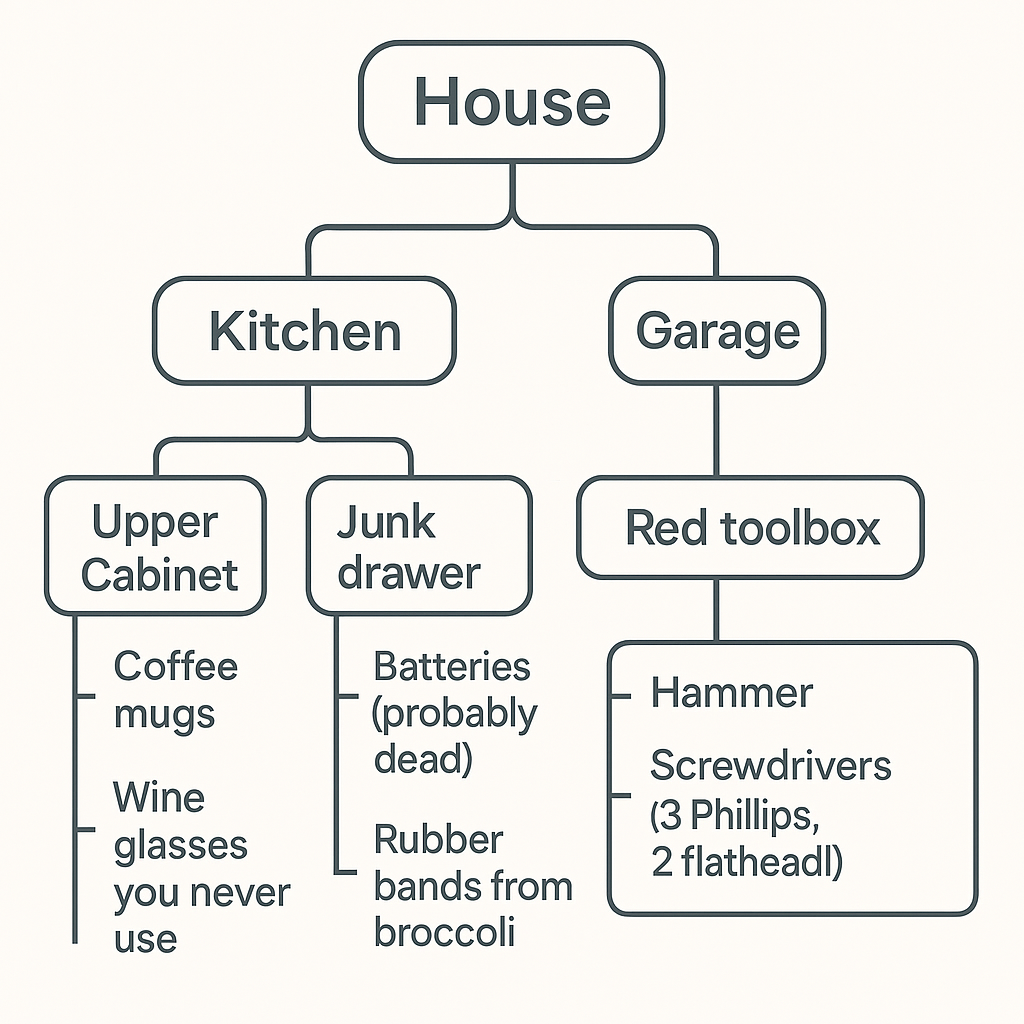
This isn't some organizational fantasy – it's how your stuff actually exists in space. Stashdog just makes that relationship searchable.
Containers vs. Tags: Know the Difference
Here's where people get confused. Tags and containers might seem similar, but they solve completely different problems:
Tags are many-to-many relationships:
- Your wireless earbuds can be tagged as
electronics,travel,workout, andexpensive-shit-I-lose - One item, multiple categories
- Great for searching and filtering
Containers are one-to-many relationships:
- Those same earbuds can only be IN one place at a time
- Your gym bag OR your desk drawer OR that mysterious black hole between your car seats
- Great for actually finding your stuff
Think of tags as describing what something IS. Containers tell you where something LIVES.
The Sharing Superpower
Here's where containers become absolutely game-changing: share a container, and you automatically share everything inside it.
Make your house a container and share it with your partner? They instantly get access to every single item you add to any room, drawer, or box in that house. No need to individually share your drill, your good scissors, or that flashlight you finally found.
The sharing hierarchy works like this:
- Share "House" with your partner → they see everything (unless it's classified)
- Share "Garage" with your neighbor → they see all your tools and lawn equipment
- Share "Kitchen" with your roommate → they know where all the good snacks are hiding
It's like giving someone keys to progressively bigger parts of your world. And if you add something new to a shared container, boom – they automatically have access to it too.
Pro tip: Got stuff you don't want to share even within a shared container? Mark it as "classified" and it stays private, even if the container is shared.
Real-World Container Examples
The Obvious Ones:
- Storage bins and boxes
- Drawers and cabinets
- Closets and wardrobes
- Toolboxes and tackle boxes
The Room-Sized Ones:
- Kitchen (contains all your cooking gear)
- Garage (contains tools, seasonal stuff, and regret purchases)
- Home office (contains work equipment and that chair you keep meaning to fix)
- Basement (contains everything you're "storing for later")
The House-Sized Ones:
- Your entire house (perfect for sharing with family)
- Vacation rental (great for group trips)
- Storage unit (for when your house container overflows)
The Not-So-Obvious Ones:
- Your laptop bag (contains charger, mouse, dongles)
- Medicine cabinet (contains first aid supplies, medications)
- Car trunk (contains emergency kit, jumper cables)
- That tote bag full of craft supplies you swear you'll use
The Weird But Brilliant Ones:
- Your "charging station" (contains all the cables and adapters)
- The "camping gear corner" in your garage
- Your partner's bedside table (contains their mysterious collection of stuff)
Why This Actually Matters
When you tell Stashdog that your drill is in the "Red toolbox in garage in house," you're creating something powerful:
- Location memory – You'll never forget where you put it
- Shared understanding – Your family knows where tools belong
- Accountability – If someone borrows your drill, they know exactly where it goes back
- Inventory awareness – You can see everything that's supposed to be in that toolbox
- Automatic sharing – Share the garage, and your neighbor automatically sees the drill
Setting Up Containers the Smart Way
Start big, then get specific:
- Begin with "House" as your master container
- Add rooms as sub-containers
- Then get into specific storage areas
- Finally, individual boxes and organizers
Create meaningful names:
- "Kitchen junk drawer" is better than "Drawer 1"
- "Camping gear bin (garage shelf)" beats "Storage container"
- "Dad's nightstand" is clearer than "Bedroom furniture"
- "Our House" tells everyone exactly what they're getting access to
Think about who else needs to find your stuff:
- If your partner might need something, share the room container
- If you're moving, containers become your best friend for unpacking
- If you're sharing items, containers tell people where things belong
- If you have kids, they can learn where things go by seeing the container hierarchy
The Container Game-Changer
Here's what happens when you start using containers properly: you stop losing shit.
Not because you're more organized (though you are), but because you've created a system that matches how the physical world actually works. Your stuff has addresses now, not just descriptions.
Your wireless earbuds aren't just "electronics" – they're "electronics that live in the small pocket of my laptop bag, which lives in the front closet, which lives in my house."
And when you share your house container with your family, they know exactly where to find those earbuds too. (And more importantly, where to put them back.)
That's not just organization. That's location intelligence with built-in collaboration.
Ready to stop treating your home like an unsearchable mess? Set up your containers in Stashdog – starting with your house – and watch your stuff finally stay where it belongs. Share the containers that matter, and suddenly everyone in your life knows where everything lives.
Because life's too short to spend it looking for things you know you own, and it's even shorter when you're the only one who knows where anything is.