
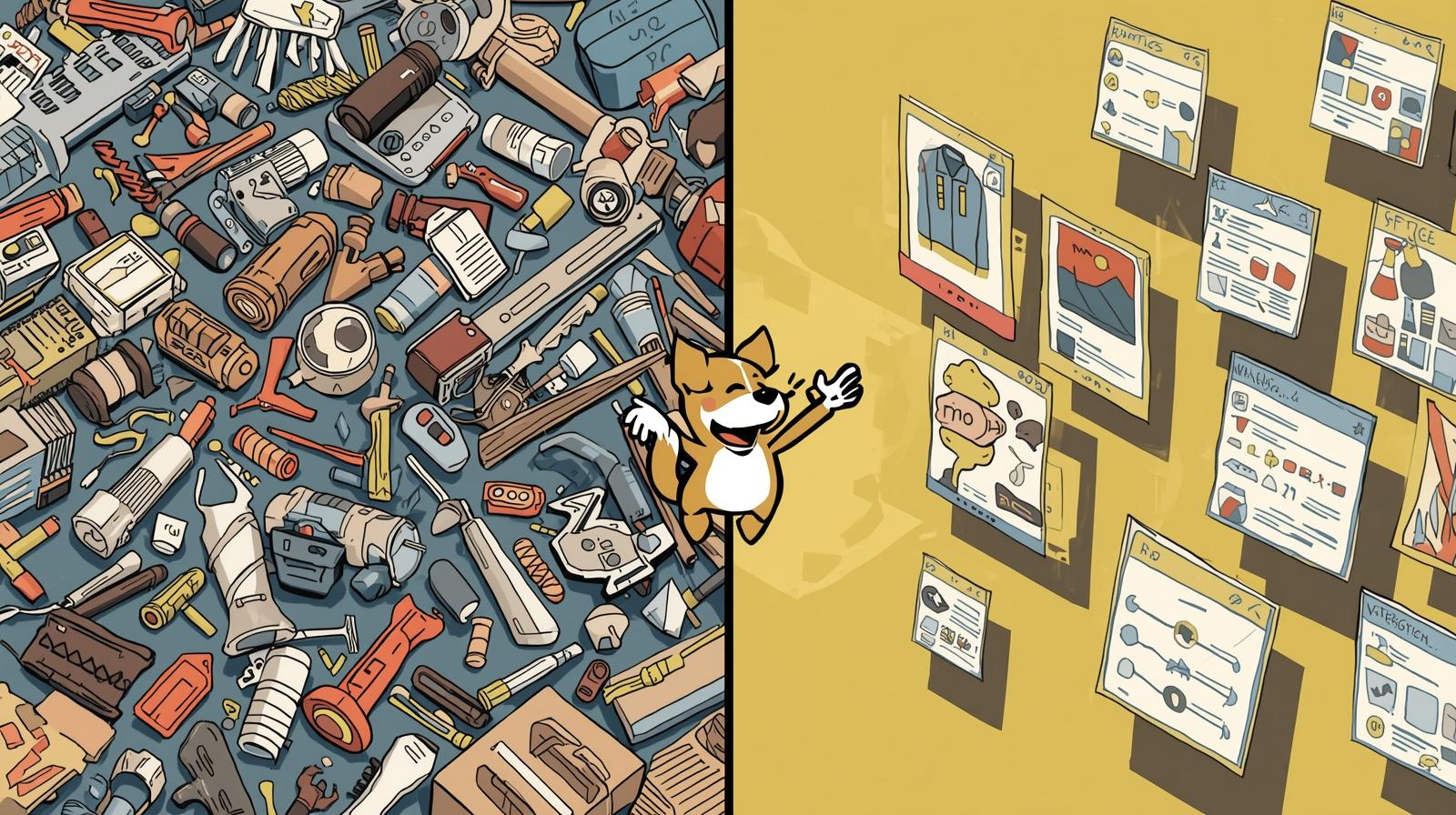
Stop Playing 'Where Did I Put That?' - The Collections Solution
We need to talk about the daily treasure hunt happening in your house.
You know you have a decent flashlight. You bought it six months ago, probably put it somewhere "safe," and now the power's out and you're fumbling around with your phone's dying battery, cursing your past self's organizational choices.
Sound familiar? Welcome to the universal human experience of losing track of your own stuff.
The Problem: Your House Is Playing Hide and Seek
Here's what's really happening: your brain organizes things conceptually ("emergency supplies," "camping gear," "things I need for this project"), but your physical space organizes things by convenience ("wherever I had room," "the closest drawer," "on top of the pile").
This disconnect creates what we call Organizational Cognitive Dissonance - or as normal humans call it, "WHERE THE HELL IS MY GOOD TAPE MEASURE?"
The Traditional Solutions That Don't Work
"A place for everything, everything in its place" - Great in theory, impossible in practice when you have 47 different categories of stuff and 12 available storage locations.
"Just remember where you put it" - If our brains were that reliable, we wouldn't need organization systems in the first place.
"Write it down somewhere" - On what? Where? In which notebook that's also lost somewhere?
The Collections Solution: Think in Groups, Not Locations
StashDog Collections solve this by letting you organize conceptually while living practically.
Instead of forcing your flashlight to live in one "correct" location, you add it to relevant collections:
- "Emergency Supplies" (because power outages happen)
- "Garage Workshop Tools" (because you also use it for projects)
- "Camping Gear" (because it's coming on your next trip)
Now when you need it, you don't have to remember its exact physical location - you just think about why you need it and check the relevant collection.
How This Changes Everything
Before Collections: Location-Based Panic
Internal monologue: "Where did I put that thing? Was it in the junk drawer? The toolbox? That bag from the last camping trip? Maybe the kitchen? Shit, maybe I left it in the car? Or did I lend it to Dave?"
Result: 20 minutes of increasingly frantic searching
After Collections: Purpose-Based Finding
Internal monologue: "I need the good flashlight for this power outage. Let me check my Emergency Supplies collection."
Result: 30 seconds to locate, grab, and get back to being a functional human
Real-World Collection Magic
The "Oh Right, I Have That" Moment
Collections surface stuff you forgot you owned. Building a deck? Check your "DIY Tools" collection and rediscover that level you bought two years ago.
The "Family Coordination" Victory
Everyone knows to check "Emergency Supplies" when they need batteries, instead of texting the family group chat "WHERE ARE THE GOOD BATTERIES?"
The "Life Scenario" Preparation
Planning a camping trip? Your "Camping Gear" collection shows everything you need, regardless of whether it's currently in the garage, basement, or bedroom closet.
Collections vs. The Alternatives
Traditional Organization Systems
- Physical filing: Rigid, breaks when life gets messy
- Room-based organization: Falls apart when items serve multiple purposes
- Category tags: Hard to remember, easy to get wrong
Collections Strategy
- Flexible groupings: Items can belong to multiple collections
- Natural thinking: Organize by purpose, not arbitrary categories
- Family friendly: Everyone understands "Emergency Supplies"
- Life-situation ready: Build collections around real scenarios
Getting Started: Your First Collection
Pick something that's currently causing you daily frustration:
"Things I Need When the Power Goes Out"
- Flashlights (wherever they currently live)
- Batteries (kitchen drawer, junk drawer, garage workbench)
- Candles (random locations throughout the house)
- Battery-powered radio (probably in the basement somewhere)
- Matches/lighter (kitchen, garage, emergency kit)
Add these items to an "Emergency Supplies" collection. Now when the lights go out, you have a shopping list of exactly what you own and a roadmap to find it all.
The Psychology of "Found"
Collections work because they match how your brain naturally categorizes information. You don't think in locations ("what's in the garage?"), you think in purposes ("what do I need for this camping trip?").
When you can't find something, your stress response kicks in. Collections short-circuit that panic by giving you a systematic way to locate things based on why you need them, not where you think they might be.
Beyond Basic Finding: Collection Superpowers
Sharing Without Chaos
Create a "Shared Tools" collection that everyone in the household can access. No more "who has the good scissors?" mysteries.
Seasonal Organization
"Holiday Decorations" collection lets you gather everything in October, regardless of which closet, attic, or basement corner it's hiding in.
Project Management
"Kitchen Renovation" collection tracks all the stuff you'll need, from tools to paint samples to measurements, even when it's scattered across multiple rooms.
The Bottom Line
You already own everything you need - you just can't find it when you need it.
Collections turn your house from a chaotic storage unit into a searchable, logical system that works with your brain instead of against it.
Stop playing hide-and-seek with your own possessions. Start thinking in collections, and finally become the organized person you've been pretending to be.
Ready to end the daily scavenger hunt? Create your first collection around something that drives you crazy to lose track of. Your future frantic self will thank you.