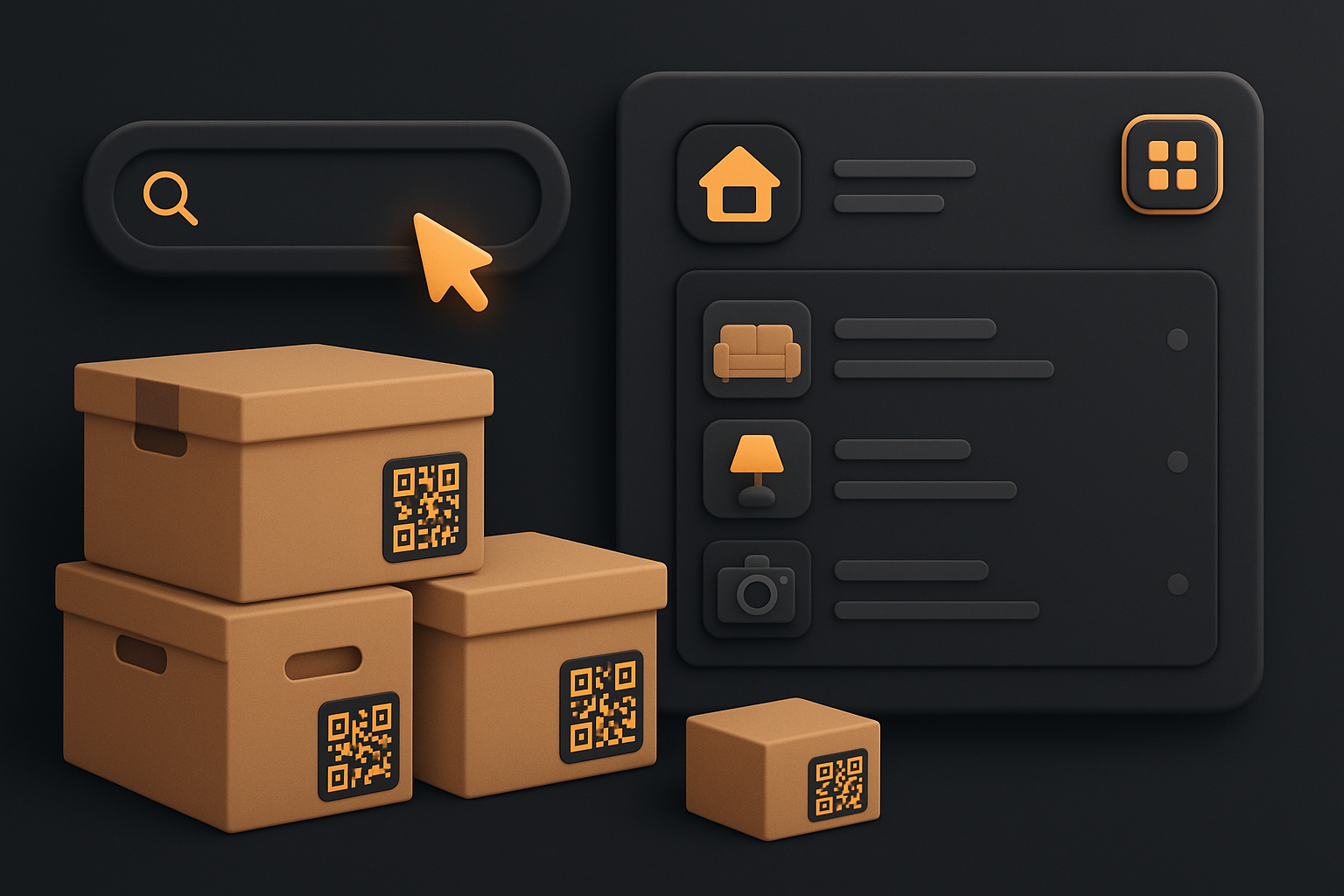
Most organization advice quietly assumes you are about to become a different person.
A person with free weekends. A person with matching bins. A person who already knows where everything should live. A person who gets a weird little dopamine hit from decanting batteries into labeled acrylic drawers.
That person is not most people.
Most people fail at organization for one simple reason: the cost shows up before the benefit.
You have to stop what you are doing, sort the pile, decide where things should go, make space there, remember that decision later, and then physically put everything away. That is a lot of friction just to get one coat off a chair or one tangle of cables off the floor.
So here is the trick: what if you stopped trying to organize for perfect placement and started organizing for fast retrieval instead?
We call that Search-First Storage.
It is the big idea behind StashDog, and it is a much more realistic way to get your home under control.
What Is Search-First Storage?
Search-First Storage is a QR code box organization method built around one promise:
You should be able to put things away immediately if you know you can find them later.
Instead of pre-optimizing where every item belongs, you do this:
- Put items into a box, bin, tote, or drawer.
- Slap a QR code label on that container.
- Catalog the contents in StashDog.
- Put the container wherever it fits.
Later, when you need something, you search for the item and StashDog tells you which box it is in.
And when you are staring at a mystery bin in the garage, you scan the QR code and see what is inside without opening it.
That is the whole move.
It sounds almost too simple, which is usually a good sign.
Why Traditional Organization Breaks Down
Traditional home organization asks you to solve four problems at once:
- What is this?
- Where should it live forever?
- What container system should I use?
- How will I remember all of that later?
That is not organizing. That is unpaid systems design.
Search-First Storage cuts the problem in half.
You do not need a perfect permanent home for every object on day one. You only need a reliable retrieval system. Once retrieval is handled, your home gets easier to improve over time because the chaos is already contained.
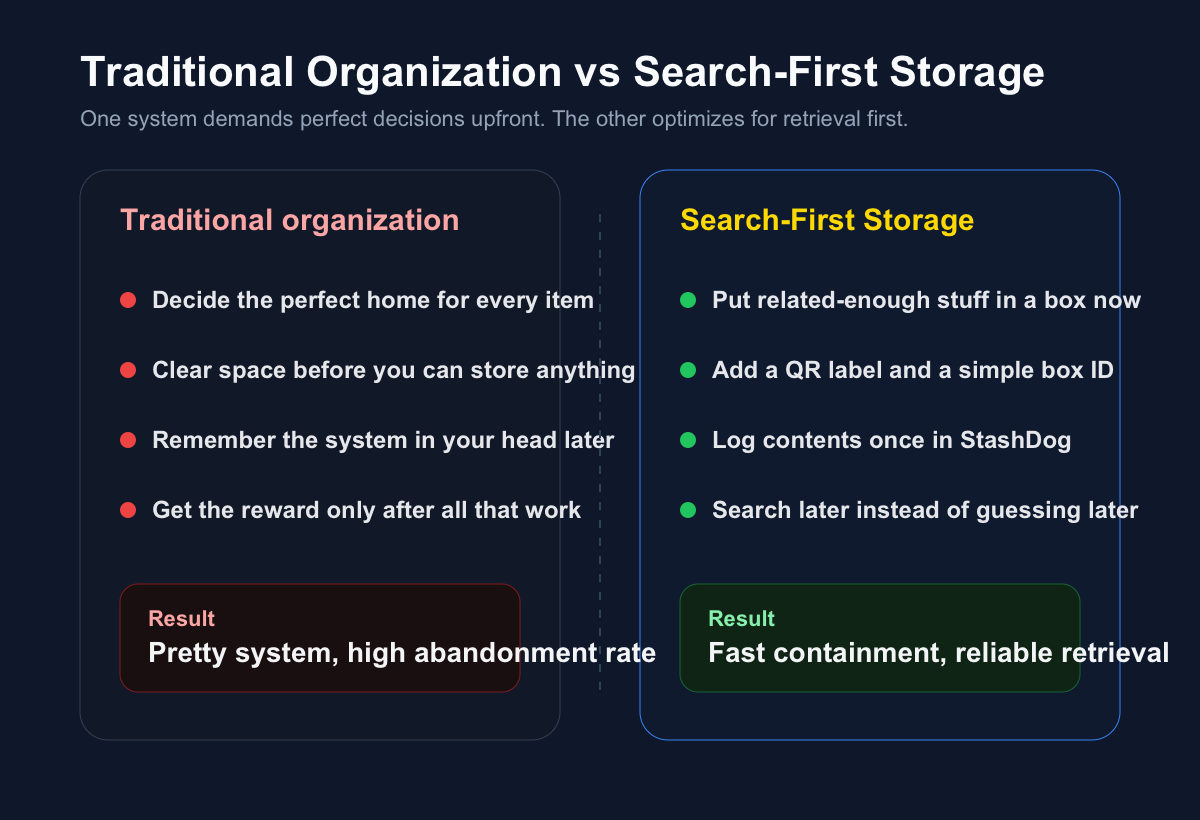
Traditional organizing demands upfront decisions. Search-First Storage gives you immediate containment and delayed optimization.
The Two Questions This Method Solves
Every storage system should answer these two questions fast:
- Where is the thing I need?
- What is in this box?
If your system cannot answer those without digging, guessing, or making a family group chat explode, your system is cosmetic.
Search-First Storage solves both.
Search for extension cord, baby winter gloves, or passport photos, and StashDog tells you the container.
Scan box B-014, and you see the list before you even cut the tape.
That is enough to make random boxes feel usable instead of chaotic.
How To Set Up Search-First Storage
You do not need a Pinterest closet. You need five things:
- Boxes, bins, or totes you already own
- QR code labels or printable stickers
- A simple box naming pattern like
B-001,B-002,B-003 - StashDog on your phone
- The willingness to stop overthinking this
Step 1: Use containers that are “good enough”
Choose cardboard boxes, plastic totes, fabric bins, or storage drawers. This method works best when you optimize for speed first.
If you are waiting to buy the perfect clear stackable modular Scandinavian storage system, congratulations, you have found a new way to procrastinate.
Step 2: Give every container a visible ID
Put a QR code on each box and pair it with a readable label like B-017.
The QR code is for scanning. The human-readable ID is for the moment when your phone is in the other room and you just need to know which ugly box is the right ugly box.
Step 3: Put related-enough things together
Not perfectly related. Related enough.
This is important.
You are not trying to build a museum archive. You are trying to get the floor clear and keep retrieval intact.
Examples:
- “Cables + spare chargers + random adapters” is a perfectly valid box.
- “Kids art supplies + sticker books + backup markers” is a perfectly valid box.
- “Winter accessories” is a perfectly valid box.
You can refine later if a category becomes too broad. The first win is getting things contained and searchable.
Step 4: Catalog the box contents in StashDog
Open StashDog, create the container record, add the label, and list what went inside.
You can log item names, notes, and photos when helpful. The point is to make future-you smarter than present-you feels.
Step 5: Put the box wherever it fits
Garage shelf. Hall closet. Top of the laundry room cabinet. Under the guest bed. Basement corner.
The physical location matters less because the retrieval layer now exists.
That is the part most people miss.
When memory is no longer your database, storage gets dramatically easier.
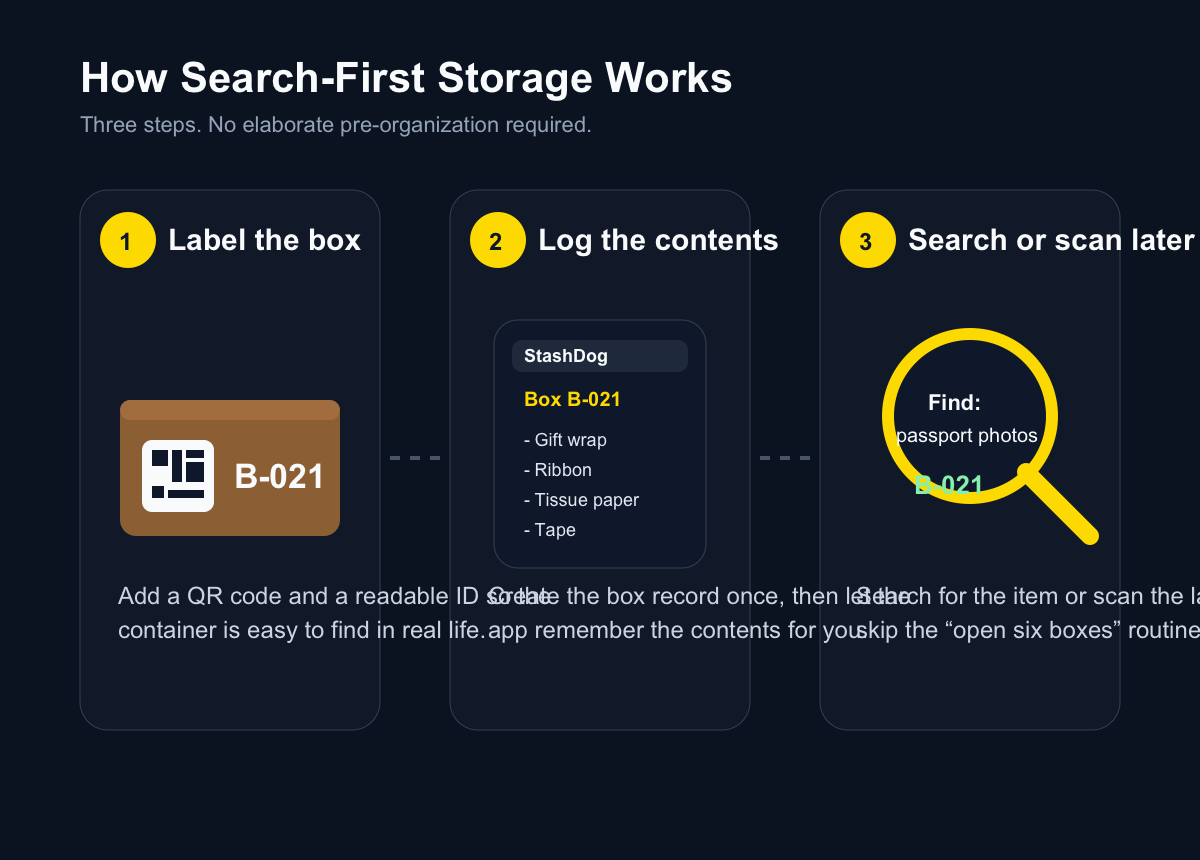
Label the box, log the contents once, then let search do the remembering.
Where This Method Works Best
Search-First Storage is especially good for the parts of home life that are too important to lose and too annoying to organize beautifully.
1. Seasonal storage
Holiday decorations, winter gloves, pool gear, back-to-school supplies, camping equipment. All of it spends most of the year out of sight anyway. The goal is not display. The goal is retrieval.
2. Kids’ stuff
Kids generate a shocking amount of category chaos. Hand-me-downs, craft supplies, sports gear, extra bedding, school keepsakes. Searchable bins beat memory every time.
3. Garage and utility zones
Extension cords, tools, paint supplies, filters, spare bulbs, hardware, cleaning extras. These spaces are where “I know I have one somewhere” goes to die.
4. Moving
This method is basically built for moving. QR-labeled boxes with searchable contents are far more useful than marker scribbles like KITCHEN??? on six identical cartons. If that is your immediate problem, start with Moving Inventory App.
5. Backup household inventory
Search-First Storage is also a practical on-ramp to a broader home inventory. If you are building that system from scratch, pair this with How to Create a Home Inventory.
Why This Feels Better Than Traditional Organizing
Because it gives you the reward early.
Traditional organizing says: work hard now, maybe benefit later.
Search-First Storage says: put the thing away right now, reduce visible chaos immediately, and trust the retrieval layer.
That instant gratification matters more than most organization experts admit.
People stick with systems that make them feel successful on day one.
They abandon systems that feel like homework.
Common Mistakes To Avoid
Making boxes too random
This is not a license to create one cursed bin full of passports, HDMI cables, birthday candles, and dog medicine.
Aim for related enough. If a box becomes impossible to describe in one line, split it.
Forgetting the box itself is the unit
You do not need a perfect record for every low-stakes object. Often the right level of detail is the box: B-021 = gift wrap, ribbon, tissue paper, tape, gift bags.
Hiding the label
Put the label where you can scan it fast. Side panel beats bottom. Every time.
Using vague names
Misc stuff is not a category. It is an admission of defeat.
Use names that future-you can actually search.
The Real Shift: Stop Organizing For Memory
Most homes are still run on memory.
That is the real problem.
You are expected to remember what exists, where it lives, what box it went into, whether you already own a backup, and whether that one random closet still has wrapping paper.
That mental overhead is the hidden tax of disorganization.
Search-First Storage offloads that tax.
Once the box is labeled and logged, your home stops depending on one person’s brain as the whole operating system.
That is also why this works well for couples, families, roommates, and anyone tired of being the designated household memory.
Who This Method Is For
This is for you if:
- You are good at putting things down but bad at creating elaborate systems
- You need household organization that survives real life
- You move, rotate seasonal gear, or use storage bins heavily
- You keep rebuying stuff because you cannot find the original
- You want fast, practical organization instead of aesthetic guilt
It is not for people who truly enjoy spending a Saturday alphabetizing spice jars into twelve custom decanters. They have their own religion.
Final Take
The reason most people stay disorganized is not laziness. It is bad system design.
When the cost of organizing comes first and the benefit comes later, people avoid the work.
Search-First Storage flips that.
You get the immediate win of putting things away now, without needing to fully pre-organize the whole house. Then you rely on QR labels, searchable box records, and StashDog to make retrieval easy later.
That is a system normal people can actually keep using.
If you want to test it, start with five boxes this week. Label them. Log them. Put your stuff away fast. Then notice how much easier your home feels when you can search instead of guess.
When you are ready, download StashDog and turn your random boxes into a system that actually works.